
When "Peace Through Strength" Failed
Last week, the White House released its proposed budget for fiscal year 2027. The budget increases federal spending from $7.4 trillion in 2026 to $7.8 trillion in 2027. The largest increase, by far, is for defense which increases 50 percent to $1.5 trillion; a White House summary, “Rebuilding Our Military,” stated:
For FY 2027, the Budget proposes $1.15 trillion in discretionary (28% increase) and $350 billion in mandatory bringing total resources for defense to $1.5 trillion. This amount exceeds even the Reagan buildup by approaching the historic increases just prior to World War II, a level that recognizes the current global threat environment and restores the readiness and lethality of our forces.
By any measure, a $1.5 trillion defense budget is huge. For perspective, in 2024 (the latest international data available), U.S. defense spending was $968 billion—36 percent of all global defense spending—while China spent $318 billion and Russia spent $151 billion.
The White House is right, though, in assessing growing global threats. China’s expansion in the South China Sea, Russia’s war in Ukraine, America’s growing involvement in the Middle East coupled with threats to annex Greenland all increase the global threat environment.

President Trump has often threatened to leave NATO. That’s unlikely though, at least legally. The 2024 National Defense Authorization Act mandates that a withdrawal from NATO would require a two-thirds Senate vote. As unlikely as that might be, a withdrawal from NATO would save, at most, $150 billion annually, and perhaps as little as $50 billion if NATO funds were redirected elsewhere. According to a recent Hudson Institute report, as of March 2025, the United States currently had 65,500 active-duty Army, Navy, and Air Force personnel stationed throughout Europe—just enough to fit into two professional football stadiums.
Could Europe stand on its own against Russia? Yes, but only if the outcome were determined solely by military spending. In 2024, the thirty-one European NATO countries plus Ukraine spent $676 billion on defense compared to Russia’s $149 billion in defense spending. That’s a huge difference, more than four to one. But NATO is hardly monolithic being composed of thirty-one European countries while Russia is a single country under a strong leader, Vladimir Putin.
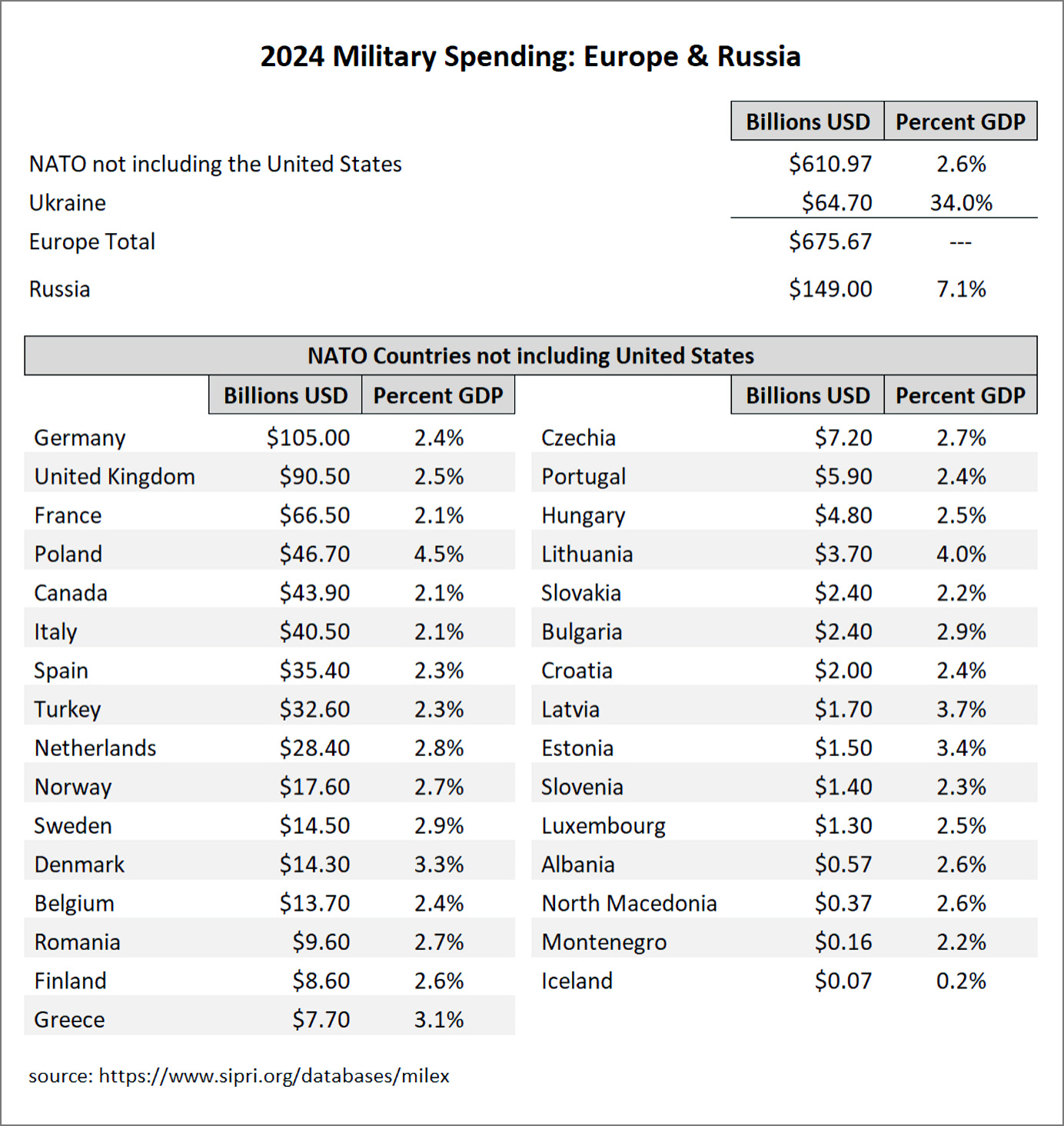
During a European war, NATO forces would be led by a Supreme Allied Commander responsible for planning and executing military operations including multinational forces across land, sea, air, cyber, and space domains. That role has traditionally been filled by a four-star U.S. general. Nor has NATO ever fought a European war; the only time Article 5 has been invoked was after the 9/11 Terrorist Attacks leading to NATO support for U.S. operations in Afghanistan. So NATO without the United States is very much untested.
The White House proposal to increase defense spending by 50 percent is nearly unprecedented. The last time the United States increased defense spending by that amount in a single year was 1950, at the outset of the Korean War. Every other similar increase, World War I and World War II, involved an active conflict with a clear objective—win the war. The current proposal by the White House is different. China, and perhaps Russia, will likely feel it necessary to counter the large U.S. increase.
History may teach a lesson here.
Starting around 1900, German Admiral Alfred von Tirpitz began to expand Germany’s battleship fleet expecting a strong German navy would restrain Great Britain from interfering in Germany’s colonial ambitions. Britain responded in 1906 with the HMS Dreadnought — a battleship so revolutionary in speed and firepower that it rendered every existing warship obsolete, including Britain’s traditional fleet.
A frantic arms race followed. Germany constructed four of the new battleships for every three Britain built. Britain was forced to respond. By 1914, Britain and Germany had together spent billions on battleships that neither country needed but felt compelled to build; in both Britain and Germany public opinion, driven by a nationalist press and warmongering politicians, demanded their nation not fall behind.
Then on June 28, 1914, with European tensions high, Archduke Franz Ferdinand was assassinated in Sarajevo by a Bosnian-Serb nationalist. The killing triggered a cascade of ultimatums and interlocking alliance obligations. By August 4, 1914, Germany and Great Britain were at war, a war that would claim seventeen million lives over the next four years.
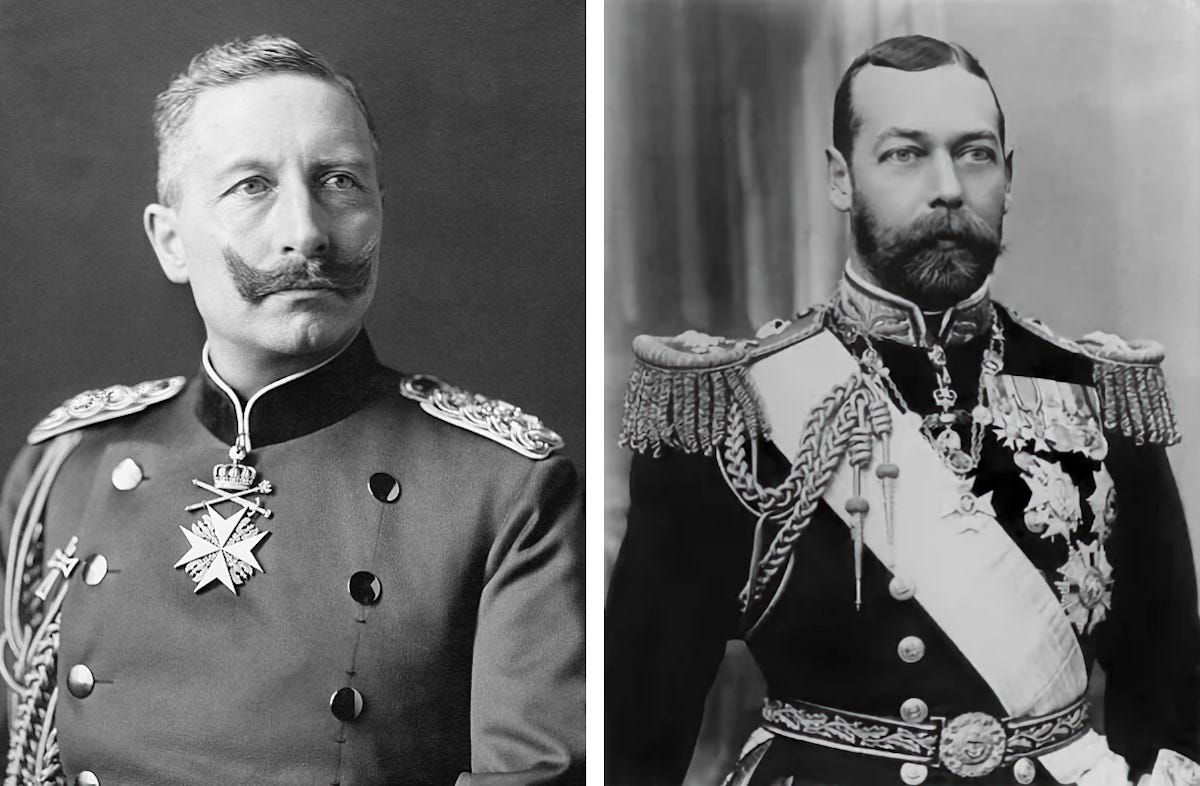
World War One was a tragedy that largely resulted from a runaway arms race. Britain and Germany had never fought a war against each other and were traditional allies. At the Battle of Waterloo in 1815, the British and Prussian armies fought together to defeat Napoleon. The two nations even shared deep family ties. Germany’s Kaiser Wilhelm II and King George V were grandsons of Queen Victoria and hence first cousins. Interestingly, during their youth the two cousins competed fiercely in yacht races. Some historians believe that their youthful family rivalry contributed to the two countries’ later competition in battleships.
Let’s hope President Trump’s defense budget doesn’t trigger an arms race with China and other countries. Only when one country dominates the global order—Rome 2,000 years ago, the United States in the years after the Second World War—does “peace through strength” discourage aggression. Otherwise, a policy of Peace Through Strength too often invites an arms race—and the tension that leads to war.